
 ACP · ETH ZURICH RSL
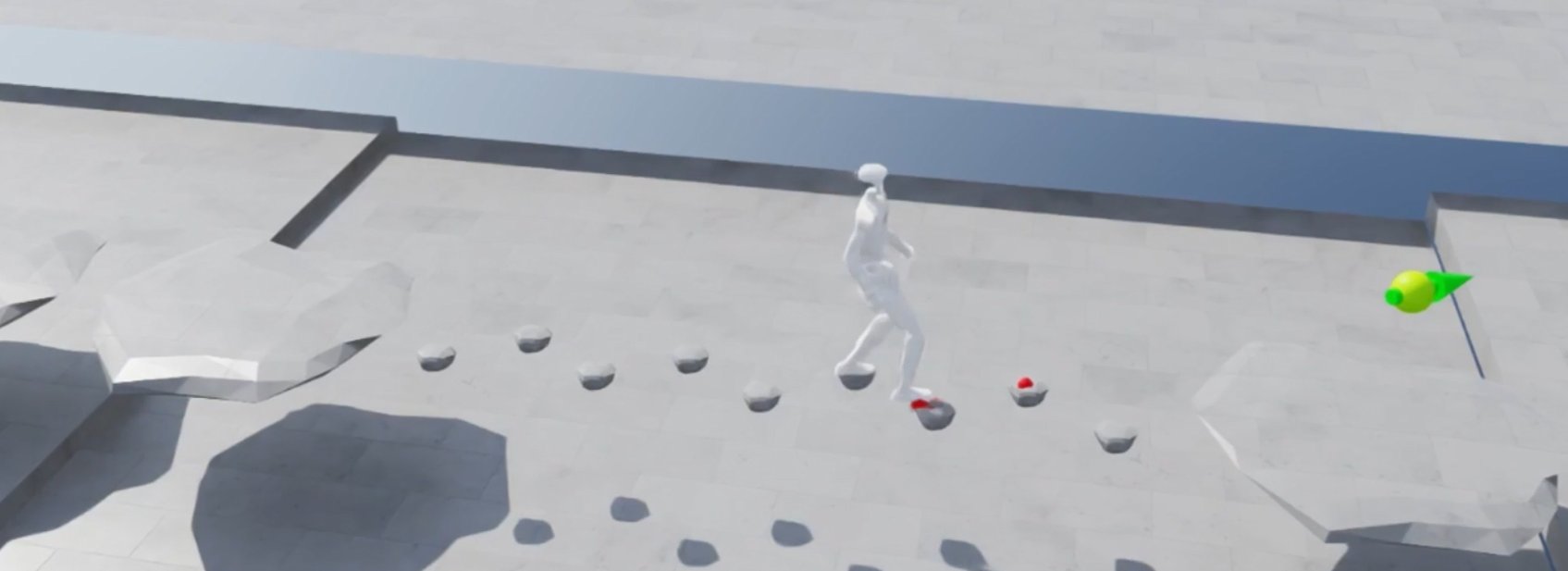
Move in the physical world through contacts.
13.2 minutes of human motion teach the robot where its hands, feet, knees, elbows and pelvis should meet the world. Reinforcement learning fills in the rest of the body. At deployment, the reference is gone: the robot plans its own contacts from a LiDAR height map and a goal, with 1 policy for every skill.
From terrain to contacts to motion
At test time, two networks run onboard at 50 Hz. The contact planner takes the height-map scans, proprioception and a goal, and predicts the next contact location for nine body parts (hands, elbows, knees, feet and pelvis) within a 1.5 s horizon. The whole-body controller takes this 9 × 3 contact plan with the height scans and proprioception, and outputs actions for the robot's 23 joints. No reference motion is used at deployment.
Explore
BibTeX
@article{acp2026humanoid,
  title   = {Humanoid Mobility via Attention-based Contacts},
  author  = {He, Junzhe and Wen, Kehan and Zhang, Chong and Schwarke, Clemens and
             Zhang, Zewei and Qu, Kaixian and Hu, Siyuan and M{\"u}ller, Matthias and
             Koltun, Vladlen and Hutter, Marco},
  journal = {preprint},
  year    = {2026}
}
Builds on
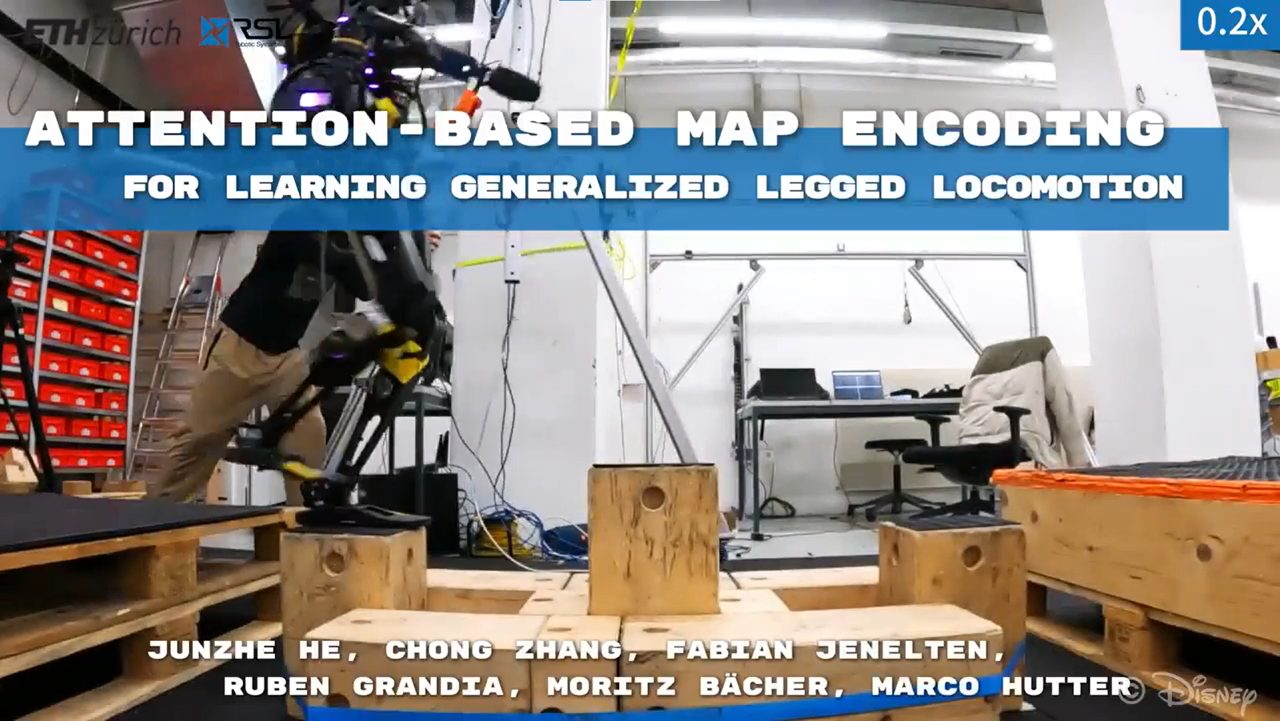
Attention-Based Map Encoding for Learning Generalized Legged Locomotion
Junzhe He*, Chong Zhang*, Fabian Jenelten, Ruben Grandia, Moritz Bächer, Marco Hutter
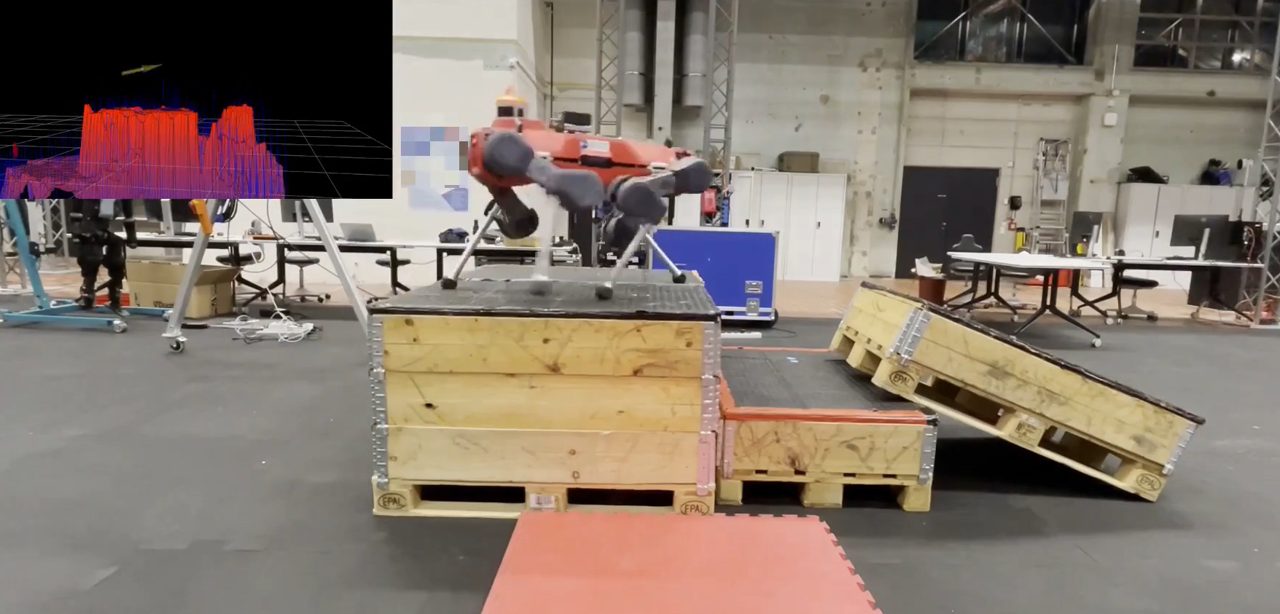
Agile and Generalized Legged Locomotion via Attention-Based Neural Map Encoding
Chong Zhang, Victor Klemm, Fan Yang, Marco Hutter
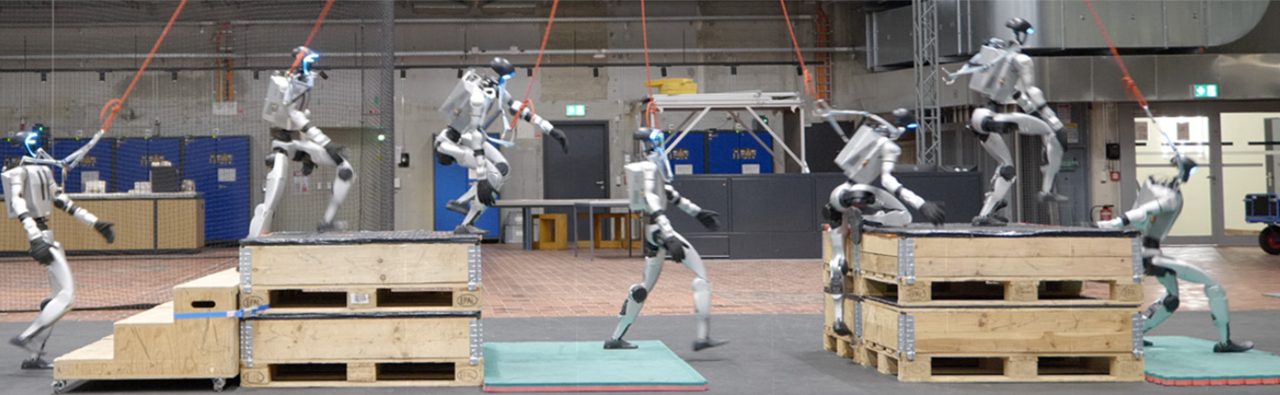
Learning Whole-Body Humanoid Locomotion via Motion Generation and Motion Tracking
Zewei Zhang, Kehan Wen, Michael Xu, Junzhe He, Chenhao Li, Takahiro Miki, Clemens Schwarke, Chong Zhang, Xue Bin Peng, Marco Hutter