Abstract
Long-range navigation is commonly addressed through hierarchical pipelines in which a global planner generates a path, decomposed into waypoints, and followed sequentially by a local planner. These systems are sensitive to global path quality, as inaccurate remote sensing data can result in locally infeasible waypoints, which degrade local execution. At the same time, the limited global context available to the local planner hinders long-range efficiency.
To address this issue, we propose a reinforcement learning-based local navigation policy that leverages path information as contextual guidance. The policy is conditioned on reference path observations and trained with a reward function mainly based on goal-reaching objectives, without any explicit path-following reward. Through this implicit conditioning, the policy learns to opportunistically exploit path information while remaining robust to misleading or degraded guidance.
Experimental results show that the proposed approach significantly improves navigation efficiency when high-quality paths are available and maintains baseline-level performance when path observations are severely degraded or even non-existent. These properties make the method particularly well-suited for long-range navigation scenarios in which high-level plans are approximate and local execution must remain adaptive to uncertainty.
Key Contributions
Path-Conditioned Architecture
A path-aware policy that encodes the full reference path with self- and cross-attention, using a learned query, and fuses it with the baseline's perceptual and proprioceptive features.
Opportunistic Training Strategy
Training on sub-optimal, noisy reference paths with an explicit shortcut reward teaches the policy to exploit path guidance when useful and disregard it when misleading.
Real-World Deployment
Validated on a Unitree B2W quadruped in a previously unseen indoor environment, transferring sim-trained behavior to long-range trajectories spanning over 90 m.
Method Overview
Path Representation & Encoding
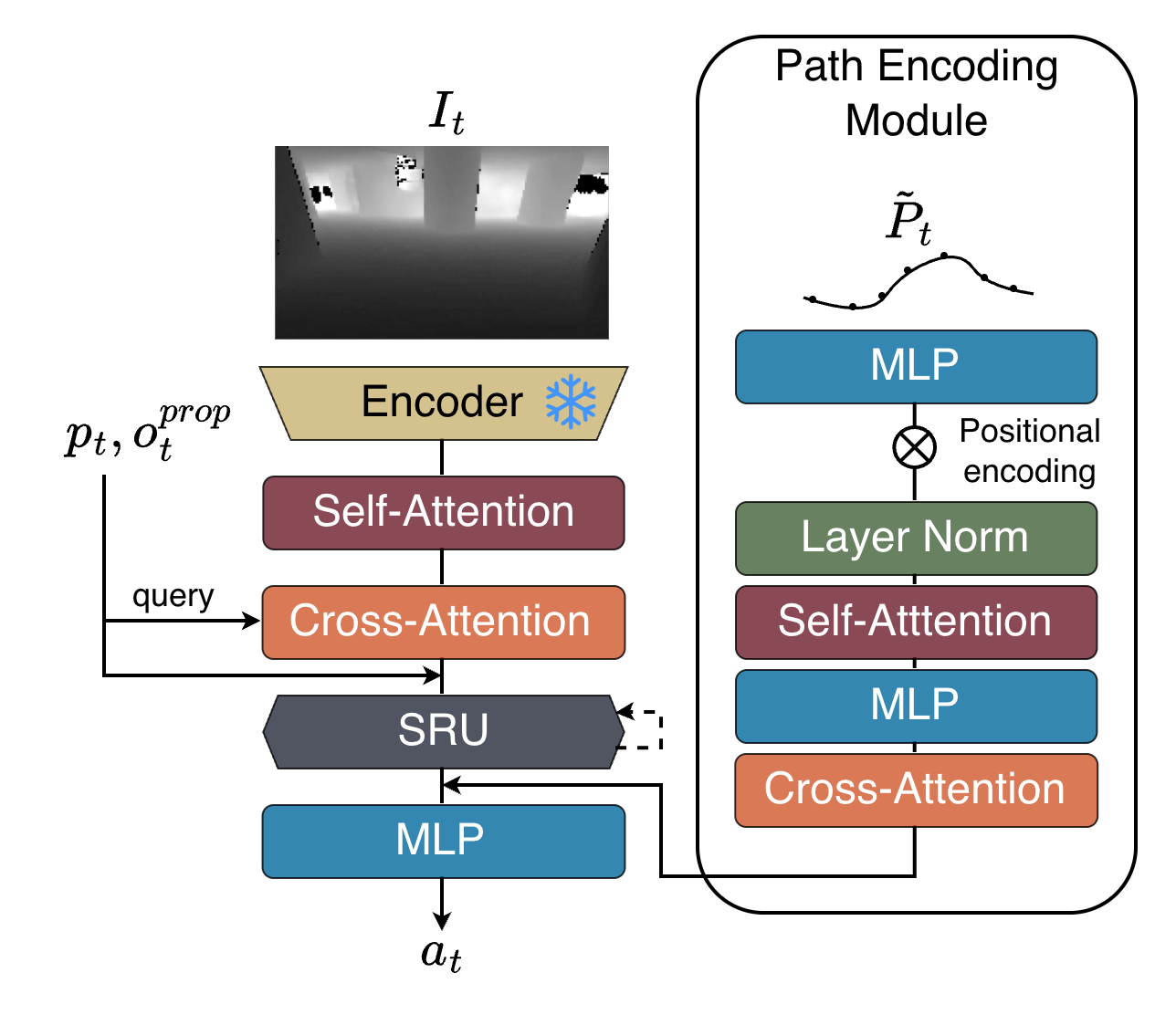
- Full-path observation: The policy observes the entire reference path, not a truncated look-ahead segment, enabling anticipatory behavior over long horizons.
- Relative waypoint encoding: Each waypoint is represented by its normalized direction and log-compressed distance to the robot, enabling generalization across path lengths and geometries.
- Self- and cross-attention: Self-attention captures global path structure; cross-attention with a learned query lets the policy focus on the most informative segments, such as sharp turns.
- Late fusion: The resulting path embedding is concatenated with the output of the spatially-enhanced recurrent unit (SRU) from the baseline navigation framework.
Training & Reward Design
- Reference path sampling: Paths are generated with A* search on a Probabilistic Roadmap (PRM) for optimal routes, or Greedy Best-First Search with a detour-biased heuristic for controlled sub-optimality.
- Waypoint noise: Random perturbations are applied to each waypoint during training, occasionally rendering paths partially infeasible, so the policy learns not to over-trust guidance.
- Goal-driven reward only: The reward combines task completion, motion smoothness, and safety penalties — there is no explicit path-following term.
- Shortcut reward: An additional reward is granted when the agent makes rapid progress along the path, explicitly reinforcing deviation from unnecessary detours suggested by the reference path.
Results
Comparison with Baseline Navigation
With an optimal reference path, the path-aware model achieves a 7.02% increase in SPL over the baseline navigation policy. Under degraded, noisy, and sub-optimal path observations, performance remains comparable to the baseline — indicating that misleading path information does not hurt navigation performance.
| Model | SR | SPL |
|---|---|---|
| Baseline | 0.83 | 0.75 |
| Our model (optimal path) | 0.87 | 0.82 |
| Our model (non-optimal & noisy) | 0.83 | 0.74 |
Ablation Study
- Architecture: Among direct concatenation, self-attention only, and cross-attention with a fixed or learned query, the learned-query variant converges fastest and reaches the highest reward, motivating its use in the final model.
- Training process: Removing waypoint noise or the shortcut reward significantly reduces robustness on degraded path observations, particularly on longer trajectories; the full model (sub-optimal paths + noise + shortcut reward) achieves the highest average success rate.
- Robustness to missing inputs: With the reference path zeroed out, the agent falls back to baseline-like unguided exploration. With the depth camera zeroed out, the agent falls back to following the waypoint sequence — showing the model degrades gracefully rather than failing outright.
Real-World Deployment
The trained policy was deployed on a Unitree B2W quadruped in a previously unseen university building, using a ZEDX depth camera and LiDAR-based state estimation. Even with an imperfect reference path, the policy biased exploration toward safer, more desirable trajectories — avoiding stair traversal and dead ends — while preserving goal-reaching performance across trajectories spanning roughly 93 m and 91 m.
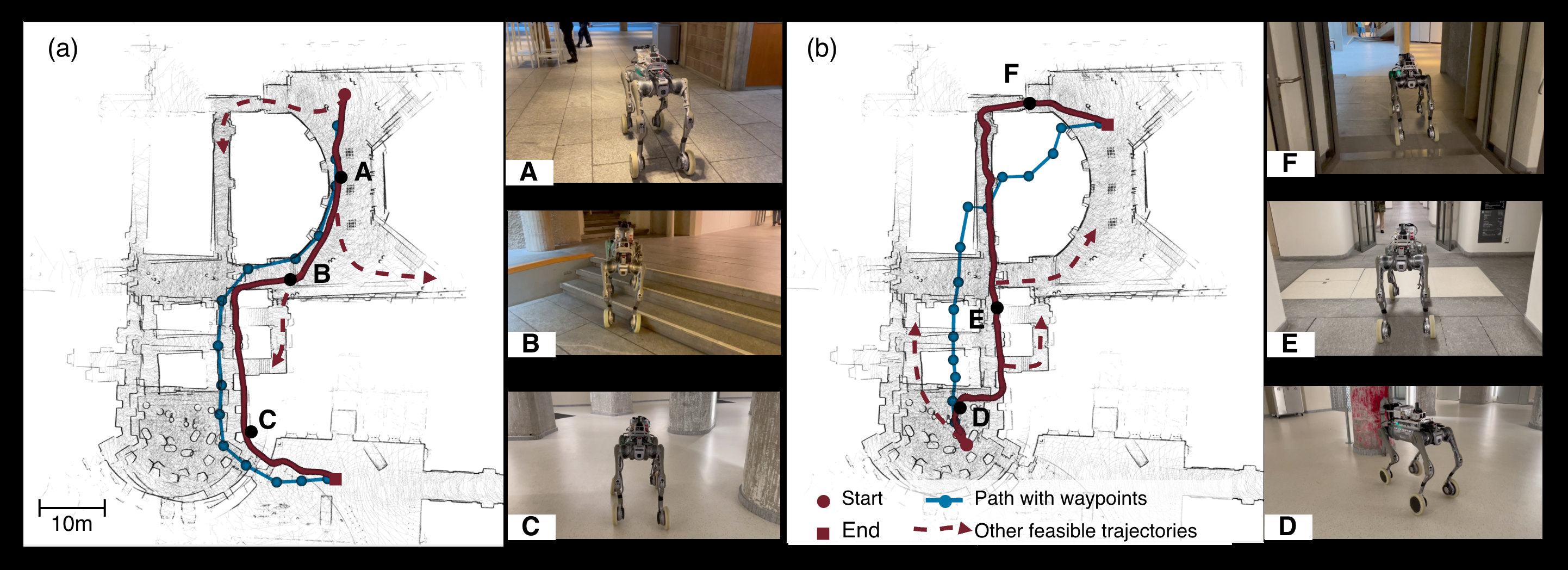
Qualitative Navigation Trajectories
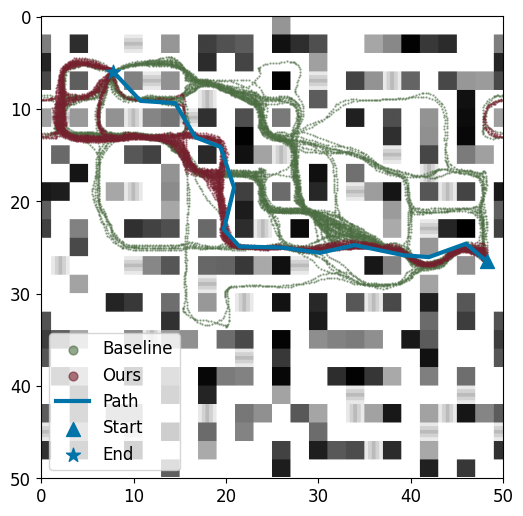
Scenario 1
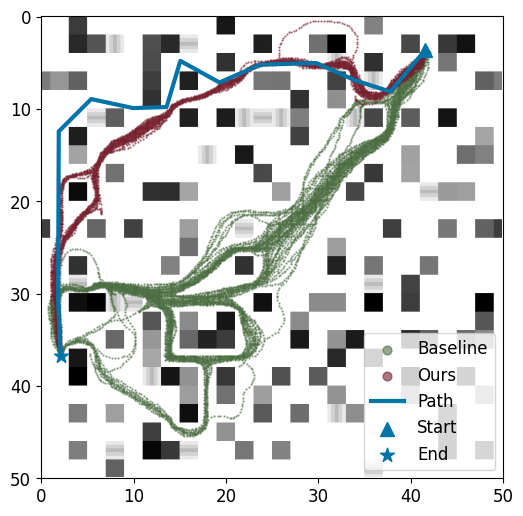
Scenario 2 – Suboptimal Path
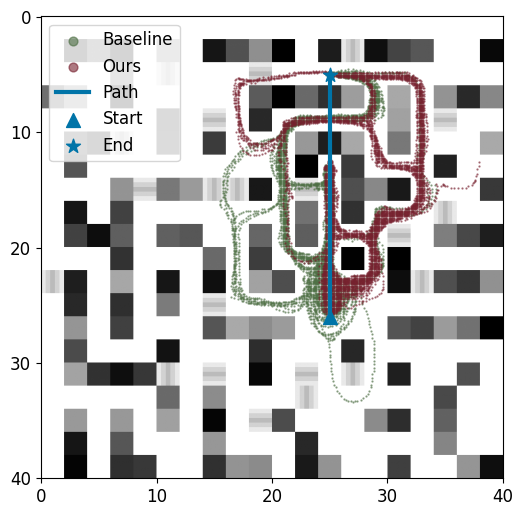
Scenario 3 – Blocked Path
Acknowledgments
Our navigation policy builds on the SRU navigation project. Visit the SRU project page for more details on the baseline method.
BibTeX
@inproceedings{haro2026pathconditioned,
          title     = {Path-conditioned Reinforcement Learning-based Local Planning for Long-Range Navigation},
          author    = {Haro, Mateo and Richter, Julia and Yang, Fan and Cadena, Cesar and Hutter, Marco},
          booktitle = {2026 IEEE/RSJ International Conference on Intelligent Robots and Systems (IROS)},
          year      = {2026},
          note      = {https://arxiv.org/pdf/2603.13888}
        }