Elevation Mapping CuPy
Real-time, GPU-accelerated elevation mapping for ROS 2 Jazzy.


This documentation tracks the actively maintained ros2 branch. The
legacy ROS 1 line remains on main.
Highlights
GPU-accelerated elevation mapping with CuPy.
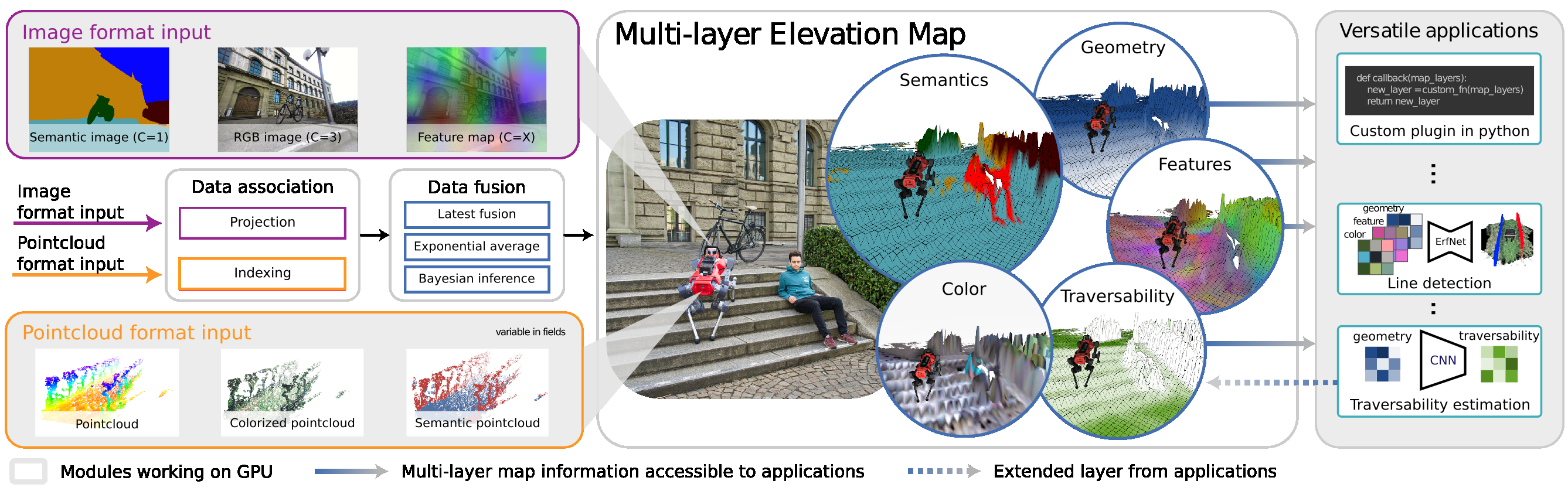
Geometry, RGB, semantic image, and semantic pointcloud fusion.
ROS 2 launch files, GridMap services, and GPU integration tests.
Deterministic fusion and reproducible performance benchmarks.
Start here
The legacy plane-segmentation stack is not part of the current ROS 2 workspace.
The supported release surface for this branch is the Python/CuPy elevation
mapping pipeline plus the restored semantic_sensor package.
Citing
If you use elevation_mapping_cupy, please cite the following paper:
Elevation Mapping for Locomotion and Navigation using GPU
Hint
Elevation Mapping for Locomotion and Navigation using GPU IROS 2022 paper
Takahiro Miki, Lorenz Wellhausen, Ruben Grandia, Fabian Jenelten, Timon Homberger, Marco Hutter
@misc{mikielevation2022,
    doi = {10.48550/ARXIV.2204.12876},
    author = {Miki, Takahiro and Wellhausen, Lorenz and Grandia, Ruben and Jenelten, Fabian and Homberger, Timon and Hutter, Marco},
    keywords = {Robotics (cs.RO), FOS: Computer and information sciences, FOS: Computer and information sciences},
    title = {Elevation Mapping for Locomotion and Navigation using GPU},
    publisher = {International Conference on Intelligent Robots and Systems (IROS)},
    year = {2022},
}
Multi-modal elevation mapping if you use color or semantic layers
Hint
MEM: Multi-Modal Elevation Mapping for Robotics and Learning MEM paper
Gian Erni, Jonas Frey, Takahiro Miki, Matias Mattamala, Marco Hutter
@misc{Erni2023-bs,
    title = "{MEM}: {Multi-Modal} Elevation Mapping for Robotics and Learning",
    author = "Erni, Gian and Frey, Jonas and Miki, Takahiro and Mattamala, Matias and Hutter, Marco",
    publisher = {International Conference on Intelligent Robots and Systems (IROS)},
    year = {2023},
}